
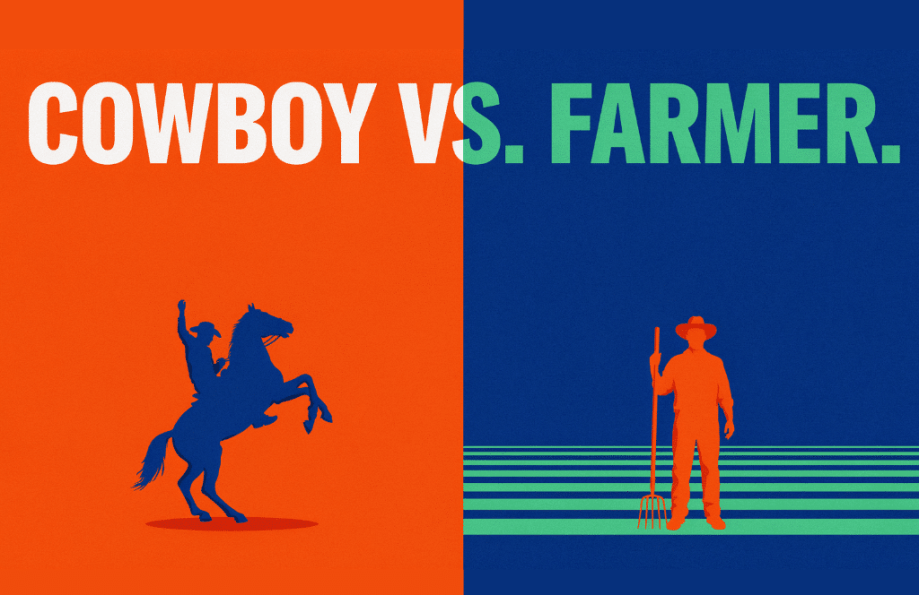
Cowboy vs. Farmer: Why Hero Culture Stops Working as You Scale.
Quick Answers: Hero Culture and Scaling
Your team is operating like a cowboy team when work depends on a few people riding in to fix problems through memory, instinct, and late nights.
Your team is operating like a farmer team when requests, plans, ownership, project knowledge, and status live in a shared system that produces reliable results without constant rescue.
Hero culture becomes a scaling problem when:
- Projects freeze while a key employee is away
- Different people give different project updates
- Requests arrive through email, Slack, meetings, and hallway conversations
- Important knowledge lives in people’s heads instead of a shared system
- New hires need months of tribal knowledge before they can work independently
- Leaders cannot see priorities, workload, or capacity without asking several people
The solution is not more bureaucracy. It is a repeatable way of working with centralized intake, visible status, clear ownership, and shared project knowledge.
The goal is not to eliminate initiative. It is to reserve heroics for genuinely unusual problems instead of making them part of the everyday workflow.
Every team has a Marcus.
Marcus rebuilt the launch deck at 11pm because the file everyone else was working from turned out to be three versions old. He knows which vendor to call when the print run comes back wrong, which VP actually has to sign off on budget, and where the good template is buried on the shared drive. When something catches fire, you text Marcus. He rides in, puts it out, rides back off into the sunset. You have never once seen him write anything down.
When your company was small, Marcus was a miracle. He was faster than any process, and process felt like overhead you couldn’t afford yet. Then you grew. More projects, more people, more departments who all need to know what everyone else is doing by Tuesday. And somewhere in there the miracle quietly turned into a hostage situation.
Marcus has become the shadow project manager your whole operation runs on without anyone actually deciding it should. The plan lives in Marcus’s head. The status lives in Marcus’s inbox. Marcus takes one long weekend and three projects freeze, because nobody else knew where they stood. (Marcus, for his part, cannot understand why he isn’t allowed to have a vacation where the phone stays in the drawer.)
That’s a stage your company grows into, not a flaw in Marcus. And a hundred years ago, the American frontier had this exact fight.
Cowboy vs. farmer: which one is your team?
For a few decades in the 1800s, the open range ran on cowboys. Cattle moved across unfenced land, driven by people who were mobile, self-reliant, and used to making the call alone because there was nobody within thirty miles to ask. Speed and instinct were the whole job. You didn’t document the trail. You rode it.
Then the farmers showed up and ruined the vibe. They fenced the land, dug in, planted, and thought in seasons instead of sprints. Their whole model was the opposite: stay put, build something that compounds, make the yield repeatable year after year. Nobody wrote a folk song about it. It just fed people, reliably, for generations.
The two went to war over one thing, and it maps onto your team with almost annoying precision. The cowboy’s advantage was the open range. The farmer’s advantage was the fence. Same land, two opposite bets on how to make it produce. The frontier rewarded the cowboy right up until the land got crowded, and then it started rewarding the farmer instead.
Mid-market teams hit that turn and mostly don’t notice it happen. The scrappy, figure-it-out-as-you-go mode that carried you from 10 people to 50 is the same mode that starts quietly costing you at 200. Your range closed a while ago. You just haven’t built the fence.
How to tell if you’re a cowboy or a farmer: 5 quick tests
You don’t need a maturity model or a consultant with a slide deck to figure this out. You need five questions, answered honestly, ideally when nobody is watching your face.
The vacation test. Send your best person completely offline for two weeks. Phone in a drawer, laptop shut, no “just one quick thing.” Does the work keep moving, or do three projects seize up until they’re back? Farmer teams barely feel it. Cowboy teams plan around that one person’s calendar like it’s a federal holiday.
The status test. Pick one active project and ask three different people where it stands. If you get three different answers, plus one “let me check with Marcus,” the status lives in people’s heads instead of anywhere you can actually look.
The intake test. Trace how the last ten requests reached your team. One front door, or some mix of hallway ask, Slack DM, forwarded email, “I mentioned it in the meeting,” and a note on a napkin? Count the channels. That number is the size of the leak.
The new-hire test. How long before someone new can find what they need and ship something without tapping a veteran on the shoulder? A few days means you have a system. A few months means your onboarding plan is “ask around until you stop being confused.”
The Monday test. Without messaging a soul, can you reconstruct what your team shipped last week and what’s due this one? If it takes a group thread and forty minutes to piece together, the plan was never written down. It was just remembered, separately, by people who remember it differently.
Add it up however you like. Flinch on three or more and you already know which hat you’ve got on.
The hidden bill for reactive project management
Reactive project management feels productive while you’re in it, which is exactly why the bill is such a surprise. It shows up late, and from a direction you weren’t watching.
The first cost is the work you never see. Cowboy operations don’t fail loudly. They fail the way strategy usually fails, quietly, through the good projects that never happened because everyone was busy smothering the loud fire. You only ever see the rescues, which is why these teams keep pinning medals on the firefighters and never ask who keeps leaving the stove on.
The second cost is a ceiling. When delivery depends on a few people holding the whole operation in their heads, you can only take on as much work as those heads can carry. So you turn down the bigger client, or you say yes and quietly pray, because you can’t actually see whether you have the capacity. Growth stops being a decision and turns into a gamble.
The third cost is a flight risk you aren’t pricing in, the thing engineers bluntly call the bus factor. Your Marcus is one better offer, one burnout, or one family emergency away from walking out with the company’s entire operating manual in his head. Nobody wrote it down, so it leaves when he does. (He is also tired, for the record. Being the system is not a promotion. It’s a quiet way to lose your best person.)
None of these land as a line item, which is precisely why they’re dangerous. The cost of staying a cowboy runs the whole time. It just stays invisible until the day it very much isn’t.
What does mature, repeatable project management look like?
Process has an image problem. Say the word in a planning meeting and watch everyone picture a Gantt chart the size of a bedsheet and a project manager whose entire personality is “just circling back on this.” That caricature has kept a lot of teams riding long after riding stopped working.
Farming isn’t bureaucracy. Farming is building a system where the work produces reliably without depending on any single person’s heroics. A cowboy team hits its deadline when its best person sprints. A farmer team hits its deadline because that’s simply what the system does now. The farmer is not less ambitious than the cowboy.
The farmer just refuses to bet the harvest on one person’s good week and clear weather. People who study this call the climb from spreadsheets and heroics to a working system a project management maturity model, and every growing team walks some version of it.
In practice it looks boring, which is the highest compliment I can pay it. Requests come in through one front door instead of five side channels, so nothing gets lost and nobody has to send the “did you get my email?” email. Everyone works off the same plan, so two teams stop quietly building two different versions of the truth. Status is something the system shows you, not something you hold a 30-minute meeting to collect.
Your best person goes on an actual vacation and the work keeps moving, because what they know lives out in the open instead of locked in their skull. That isn’t slower. It’s the only version that survives a growth spurt.
Why do project management tools fail when teams try to scale?
Most mid-market teams already know they’ve outgrown the cowboy stage. They stall anyway, because the tools sold to move them into the farmer stage tend to make things worse before they make them better.
Half the market sells you a bigger, faster horse. Enterprise platforms with 500 features, a six-month implementation, a $20K consultant, and enough complexity that you need a full-time admin whose only job is maintaining the tool that was supposed to save you time. You wanted to stop depending on heroics, and you accidentally bought a system that requires them.
The other half sells you something so light it folds under a serious workload, you hit the ceiling around 50 projects, and you slink back to the spreadsheet you swore you’d left behind.
So teams keep riding, because the cowboy way is at least a familiar kind of hard, and familiar feels safer than one more rollout that dies in month three. The fence never gets built. The cost of skipping it climbs every year and never once shows up as a line item.
How to fix key person dependency without hiring a fence crew
The fix isn’t a heavier tool or another standing meeting. It’s moving the handful of things that quietly run your operation out of people’s heads and into the open. You can start this week, whatever software you’re on.
Give every request one front door. Route intake through a single method and retire the rest. The hallway ask, the Slack DM, the forwarded email all become one form or one channel, so nothing gets lost and every request is visible the second it lands.
Turn status into a place, not a meeting. Put project status somewhere anyone can check without asking a person. That shared view is what project visibility actually means, and it retires most status meetings on contact.
Get what’s in Marcus’s head onto paper. Book one hour and document the three things he knows that nobody else does: the vendor, the approval path, where the good files live. Boring, and probably the highest-leverage hour on your calendar this quarter.
Give every project one named owner. Not five stakeholders and a shrug. One person accountable for moving it, with roles mapped so nobody has to wonder who owns what. A one-page RACI matrix is enough to start.
Make one plan the source of truth. Kill the private side-spreadsheets and the parallel versions. One plan, updated in the open, so two teams stop building against two different realities.
That’s the whole idea behind Workzone: intake in one place, status you can see instead of chase, and a plan that lives in the open instead of in Marcus’s memory. It’s the farmer’s setup without the six-month rollout, so you can build the fence and keep working the same week. If you want to see it in motion, take the product tour.
The cowboy gets the statue. The farmer gets the town.
We romanticize the cowboy and forget the farmer because the cowboy is a better story. Wide open spaces, no boss, no paperwork. But the towns still standing were built by the people who fenced the land, planted something, and made it produce year after year without needing to be rescued.
Your Marcus is an asset. Keep him, promote him, point that instinct at the genuinely weird problems that need a human who thinks fast. Just stop asking him to be your operating system. Key person dependency is not loyalty, it is a limit you eventually hit at full speed. After 23 years watching mid-market teams make this exact turn, we can tell you the ones that pull ahead are the ones that finally stop riding and start building. Your range closed a long time ago. The only thing left to decide is how long you make everyone wait to work the land you already have.
See how Workzone helps your team see everything and chase nothing. Start a free trial.
Frequently Asked Questions
What is the difference between cowboy and farmer project management? Cowboy project management is reactive and personality-driven: work moves because a few fast, capable people ride in and rescue it through memory, instinct, and late nights. Farmer project management is systematic: work produces reliably because intake, status, and plans live in a shared system instead of in individual heads. Most teams start as cowboys and need to become farmers as they scale past roughly 50 people.
What is key person dependency, and why is it a risk? Key person dependency is when critical work only moves because one or two specific people are around to move it, usually because the process, the status, and the institutional knowledge all live in their heads instead of in a system. It’s a risk because it caps how much work you can take on, hides how close projects are to slipping, and means one resignation or burnout can walk your operating knowledge out the door. The fix is getting that knowledge into the open through shared intake, visible status, and a plan anyone can follow.
How do I know if my team has outgrown reactive project management? Run a few quick tests. If your best person can’t take a two-week vacation without projects stalling, if three people give three different answers about where one project stands, or if new hires take months to get productive because nothing is written down, you have outgrown the reactive stage. The more of those that sting, the more urgent the shift.
What are repeatable project management processes? Repeatable project management processes are the systems that let work produce the same reliable result no matter who is in the building: a single front door for requests, a shared plan everyone works from, and status the system surfaces on its own instead of a meeting collecting it by hand. The goal is not more bureaucracy. It is hitting deadlines because the system does it, not because one person sprinted.
How do you fix key person dependency without slowing the team down? You do not need a heavier tool or more standing meetings. You move three things out of people’s heads and into the open: where requests come in, where the work stands, and who owns what. When intake, status, and plans are visible to everyone, the team actually moves faster, because nobody is stuck waiting on one person to unblock them.
Does this only matter for large companies? No. Key person dependency usually bites hardest in the mid-market, roughly 50 to 1,000 people, where teams have outgrown scrappy tools but cannot absorb enterprise complexity. Smaller teams can run on heroics for a while. The trouble starts when the volume of work outgrows what a few people can personally hold in their heads.
Last updated on July 29, 2026
Want a Peak Inside Workzone?

Continue reading

Ready To See Workzone In Action?
Simple project management software with real people ready to help you get started.


