
Why Teams Lose Visibility Across Projects As They Scale
Summary
As organizations grow, project visibility becomes harder to maintain across departments, stakeholders, and priorities. Teams often rely on spreadsheets, meetings, and disconnected updates to understand project status, which creates delays, hidden risks, and operational confusion. Project portfolio visibility helps organizations centralize project tracking so leadership and teams can see progress, deadlines, risks, and priorities across the business in real time.
Key Takeaways
- Portfolio visibility helps teams track project status across departments
- Manual reporting processes create operational delays and hidden risks
- Disconnected tools make it difficult to understand project health
- Centralized portfolio tracking improves accountability and decision-making
- Real-time visibility helps organizations identify issues earlier
Managing one project is difficult enough.
Managing dozens or hundreds across departments, stakeholders, deadlines, and priorities is where visibility starts breaking down.
At first, most organizations think the issue is communication.
So they add:
- more meetings
- more spreadsheets
- more dashboards
- more status updates
- more project check-ins
But visibility usually does not improve.
In many cases, it gets worse.
That is because the problem is not a lack of information.
The problem is that information lives in too many disconnected places.
Marketing has one view.
Operations has another.
Leadership sees a slide deck once a week.
Project managers manually piece together updates from emails, spreadsheets, and team conversations.
The result is delayed decisions, hidden risks, and teams reacting to problems long after they should have been identified.
What Poor Portfolio Visibility Actually Looks Like
Most organizations do not realize they have a portfolio visibility problem at first.
The symptoms usually appear operationally before leadership connects them back to visibility.
That often looks like:
- leadership asking for constant status updates
- teams maintaining separate spreadsheets
- conflicting project priorities across departments
- delayed identification of project risks
- project managers manually gathering updates
- executives discovering issues after deadlines slip
- teams duplicating work because visibility is fragmented
- reporting taking hours or days to assemble
As organizations scale, these inefficiencies compound quickly.
Instead of proactively managing execution, teams spend increasing amounts of time trying to understand where projects stand.
What Is Project Portfolio Visibility?
Project portfolio visibility gives organizations a centralized way to view the status, health, deadlines, priorities, and progress of projects across the business.
Instead of managing projects individually, teams can see how work is progressing across the organization in real time.
This becomes increasingly important as organizations grow because project dependencies, resource conflicts, and shifting priorities become harder to track manually.
A strong portfolio view helps teams:
- identify projects at risk
- monitor deadlines across departments
- prioritize work more effectively
- reduce reporting overhead
- improve executive visibility
- align teams around shared priorities
Without it, most organizations end up operating reactively.
Why Traditional Reporting Stops Working
Many growing teams rely on manual reporting processes.
That often includes:
- spreadsheets
- PowerPoint updates
- weekly meetings
- manual status collection
- disconnected reporting tools
The problem is that these methods become outdated almost immediately.
By the time leadership reviews a status update, priorities may have already changed.
Teams also spend enormous amounts of time preparing updates instead of executing work.
This creates operational drag that slows decision-making across the organization.
The Hidden Cost of Poor Portfolio Visibility
When organizations lack visibility across projects, the consequences usually appear in subtle ways first.
Deadlines start slipping.
Teams become overloaded.
Approvals slow down.
Competing priorities emerge.
Leadership loses confidence in timelines.
Over time, these small issues compound into larger operational problems.
Poor visibility often leads to:
- missed deadlines
- duplicate work
- delayed decisions
- resource conflicts
- inefficient prioritization
- lack of accountability
- stakeholder frustration
Most organizations do not realize how much time is lost simply trying to understand where projects stand.
When Teams Start Evaluating Portfolio Management Software
Most organizations begin evaluating portfolio management software when project coordination becomes difficult to manage manually.
The tipping point usually looks like this:
- multiple departments managing interconnected projects
- reporting becoming too time-consuming
- leadership lacking confidence in project visibility
- competing priorities creating operational conflicts
- resource allocation becoming difficult to track
- project risks surfacing too late
At this stage, teams are no longer trying to manage individual projects.
They are trying to manage organizational execution at scale.
How Workzone Improves Portfolio Visibility
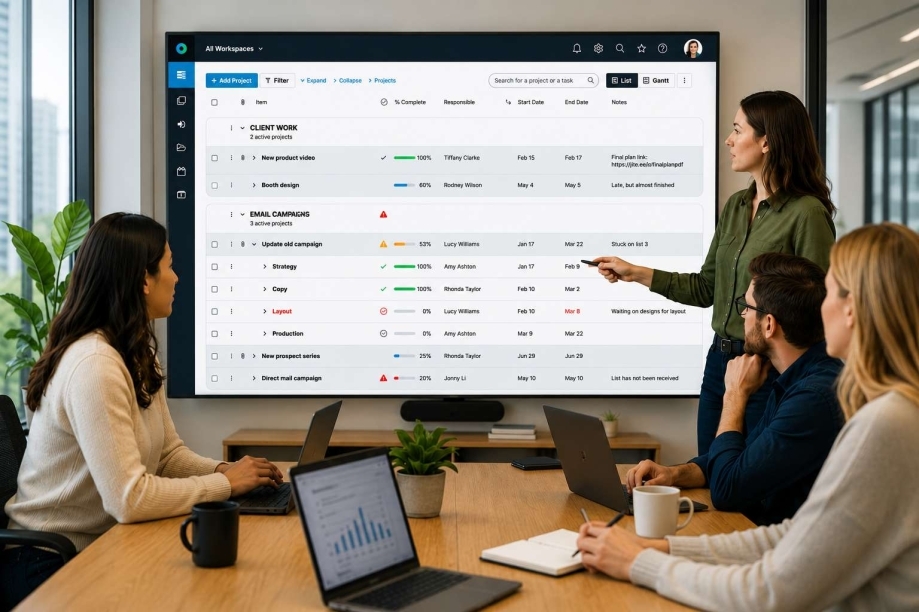
Workzone’s Portfolio View gives teams a centralized way to track projects, deadlines, status updates, ownership, and progress across the organization.
Instead of managing projects in isolation, teams can monitor work across departments from a single view.
This allows organizations to:
- quickly identify projects at risk
- monitor project health in real time
- improve cross-functional alignment
- reduce manual reporting
- streamline executive updates
- make faster operational decisions
Leadership gains clearer visibility into organizational priorities while project teams spend less time chasing updates and building reports manually.
Capability-to-Outcome Mapping
| Portfolio Visibility Capability | Operational Outcome |
|---|---|
| Centralized project tracking | Improved visibility across departments |
| Real-time status reporting | Faster leadership decision-making |
| Shared portfolio views | Reduced reporting silos |
| Cross-project visibility | Earlier identification of risks |
| Centralized dashboards | Less manual reporting overhead |

Related Workflow Challenges
Teams struggling with portfolio visibility often also experience:
- workload imbalance
- reporting delays
- approval bottlenecks
- project prioritization conflicts
- disconnected communication
- lack of executive visibility
Final Thoughts
Most organizations do not struggle because teams are unwilling to work hard.
They struggle because visibility breaks down as complexity increases.
Portfolio visibility helps teams understand not just individual projects, but how work connects across the organization.
That visibility becomes critical for making better decisions, improving accountability, and keeping projects moving forward.
If your organization still relies on spreadsheets, disconnected updates, or manual reporting to understand project health, it may be time to rethink how visibility is managed across your portfolio.
FAQs
1. What is project portfolio management software?
Project portfolio management software helps organizations track, prioritize, coordinate, and report on projects across departments and teams from a centralized system. It improves visibility into project status, deadlines, risks, workloads, and organizational priorities.
2. What is project portfolio visibility?
Project portfolio visibility is the ability to monitor project status, deadlines, risks, priorities, and progress across multiple projects and departments from a centralized view.
3. Why is portfolio visibility important?
Portfolio visibility helps organizations improve decision-making, reduce reporting overhead, identify risks earlier, and keep teams aligned across projects and priorities.
4. What causes poor project visibility across teams?
Poor project visibility is often caused by disconnected tools, manual reporting, fragmented communication, inconsistent project tracking, and lack of centralized visibility across departments.
5. When do organizations need project portfolio management software?
Organizations typically begin evaluating project portfolio management software when managing projects across multiple departments becomes difficult to coordinate manually and leadership lacks clear visibility into project status, risks, and priorities.
6. How do teams lose visibility across projects?
Teams often lose visibility when project information becomes fragmented across spreadsheets, emails, meetings, disconnected reporting systems, and inconsistent project tracking processes.
7. How does project portfolio management software improve reporting?
Project portfolio management software improves reporting by centralizing project data, automating status visibility, reducing manual updates, and helping leadership monitor deadlines, risks, and progress in real time.
8. What are the benefits of project portfolio management software?
Project portfolio management software helps organizations improve visibility, reduce reporting overhead, identify project risks earlier, improve cross-functional collaboration, balance workloads, and make faster operational decisions.
9. What is the difference between project management and portfolio management?
Project management focuses on managing individual projects, while portfolio management focuses on visibility, prioritization, coordination, reporting, and resource planning across multiple projects and teams.
10. Why do spreadsheets fail for project portfolio visibility?
Spreadsheets often fail for portfolio visibility because they require manual updates, become outdated quickly, and do not provide real-time visibility into project status, workload, risks, dependencies, or cross-functional priorities.
11. How does portfolio visibility improve cross-functional collaboration?
Portfolio visibility improves cross-functional collaboration by giving departments shared visibility into priorities, deadlines, ownership, dependencies, and project status across the organization.
12. What are the benefits of portfolio management software?
Portfolio management software helps organizations centralize project tracking, improve reporting, reduce manual work, increase operational visibility, and improve coordination across departments and stakeholders.
Last updated on May 27, 2026
Want a Peak Inside Workzone?

Continue reading

Ready To See Workzone In Action?
Simple project management software with real people ready to help you get started.


