
Why the Best Multi-Site ABA Marketing Teams Run Differently
Multi-site ABA is growing fast, and it isn’t slowing down. In the U.S. ABA market keeps climbing, and private equity alone bought up 574 autism service sites across 42 states between 2015 and 2024. Groups that ran 30 clinics three years ago are running 120 today. Marketing feels that growth first, because census targets, brand consistency across every location, de novo launches, and folding in acquisitions are all marketing’s job. And almost everywhere we look, the same thing is happening: the marketing team is scaling faster than the way it works.
We’ve spent more than two decades inside multi-site healthcare organizations, and we benchmarked how ABA marketing teams actually operate as they grow from 10 clinics to 500-plus. At every size, the work gets done. What changes is whether it lands the same way everywhere: on time, on brand, with approvals you could show an auditor. The problem is never the work itself. It’s the coordination around it.
That coordination tends to break at four predictable points, and at each one the challenge changes in kind, not just in volume.
How does multi-site ABA marketing change as you scale?
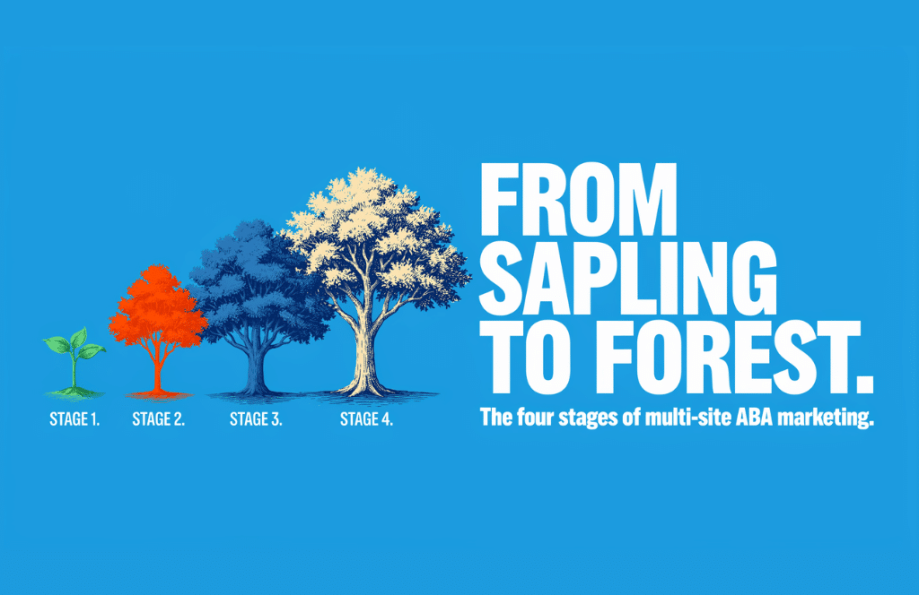
Multi-site ABA marketing moves through four stages as a group grows, each one defined by the way the team is forced to work and the moment that way of working gives out.
Tier 1, 10 to 75 clinics. A marketing team of one to six people covers a footprint that has outgrown spreadsheets but isn’t big enough yet to justify a dedicated marketing-ops function. The whole thing runs on what people carry in their heads. It stops working the moment the CMO can’t name every clinic director and every campaign in flight from memory anymore.
Tier 2, 75 to 175 clinics. The Visibility Cliff. This is where most groups get stuck. The portfolio is too big to hold in one person’s head and too small to justify a full ops function, so regional managers and local directors start running their own campaigns. It stops working the moment the CMO can’t pull an accurate, current picture of everything in flight without asking three different people.
Tier 3, 175 to 300 clinics. Operational Drag. The team now stretches across corporate, regional, and shared services, and it cranks out plenty of work. It stops working the moment more than 30% of the team’s time disappears into coordination, status updates, and rework instead of the actual work.
Tier 4, 300 to 500-plus clinics. Enterprise at Scale. Marketing is a P&L line now, and governance becomes the job. It stops working the moment the question changes from whether the work is getting done to whether the right work is getting funded, and whether you can prove it.
Underneath all four, it’s the same failure mode. A clinic opening that slips, two sites 20 minutes apart running different versions of the same promotion, a compliance review buried in an email chain. None of it looks like one big failure. It’s a steady tax you pay every single week, and it’s exactly the kind of thing a deliberate operating model clears out. It’s also the gap a platform like Workzone is built to close, by giving every clinic and every campaign one shared place to live.
What do the best multi-site ABA marketing teams do differently?
The top groups aren’t working harder than everyone else. They put a shared operating layer in place before the strain forces their hand. That layer is the kind of system Workzone was built to be, and it really comes down to a handful of capabilities.
One front door for every request, so nothing lands in the queue half-formed and leadership can see what’s coming. Templated playbooks for de novo openings and acquisitions, so every launch starts from a plan that already works and a slip shows up the day it happens, not the week the clinic opens. A governed asset library that’s faster to pull from than to rebuild, which is the only thing that actually keeps brand consistent across locations. Structured approvals with named owners and a record of every version for compliance and clinical review, the same discipline a RACI matrix brings to who signs off on what. And one portfolio view that answers the on-track question for the CMO, the regional VPs, and the PE sponsor without anyone building it by hand.
Put this in before Tier 3 and it does a lot more than speed projects up. It hands leadership back the hours that were going to status-chasing and firefighting, and it takes much of the risk out of the next de novo wave or acquisition. Building that marketing-ops muscle is exactly the work a fast-growing group never feels like it has time for, which is why most teams put it in a tier later than they wish they had. If you want the full version, with all four tiers, the eight stage-by-stage challenges, and a two-minute self-audit, it’s in the Multi-Site ABA Marketing Benchmark, and there’s a companion operations brief for the COO side.
Find your tier in the benchmark
The four tiers, the eight challenges that surface at each one, and a two-minute self-audit are all in the Multi-Site ABA Marketing Benchmark. It scores your operating maturity against peer groups at your clinic count and points to the specific gaps to close first, with a companion operations brief for the COO side. It is the fastest way to see where your team stands today and what the next stage will ask of it.
Workzone is the shared operating layer many of these groups put underneath the work. It runs multi-site launches as one plan, keeps intake and brand assets in one place, routes compliance and clinical approvals with a full audit trail, and rolls every location into a single portfolio view, all SOC 2 Type II compliant and HIPAA-ready. Brian Taylor, Director of Project and Portfolio Management at Tampa General Hospital (173 care sites), described the change plainly: We were getting things done, but our team was getting crushed. Workzone helped us get out of survival mode.
Start with the benchmark to find your tier. When you want to see what that operating layer looks like in practice, you can schedule at quick chat for 15 minutes..
Frequently asked questions
At what size do multi-site ABA marketing teams start to break down? Multi-site ABA marketing breaks at four predictable clinic counts, not gradually. The hardest is the “Visibility Cliff” between roughly 75 and 175 clinics, where the portfolio is too large to track from memory but too small to justify a dedicated marketing-operations function, so regional and local teams start launching on their own and corporate loses the single source of truth. The Workzone Multi-Site ABA Marketing Benchmark maps all four tiers and the inflection point that ends each one.
What is the best project management software for a multi-site ABA or clinic group? The right fit for a multi-site ABA group standardizes intake, runs de novo openings and acquisition integrations from repeatable templates, governs brand assets, routes compliance and clinical approvals with an audit trail, and rolls every location up into one portfolio view. Workzone is built for this, with 23 years of healthcare experience, SOC 2 Type II compliance, HIPAA-ready BAA support, and customers like Tampa General Hospital running 173 care sites.
How do I keep brand consistent across many ABA clinic locations? Brand consistency across locations comes from making the approved assets easier to use than recreating them. A governed, versioned asset library plus a single intake path means every clinic pulls from the same shelf and corporate sees outbound work before it ships, not after a parent flags it. This is one of the habits the benchmark found separating top-quartile ABA groups from the rest.
How much time do multi-site marketing teams lose to coordination? At the “Operational Drag” tier (roughly 175 to 300 clinics), the Workzone benchmark found that more than 30% of a marketing team’s time goes to coordination, status updates, and rework rather than producing work. Installing a shared operating layer (single intake, templated launches, portfolio reporting) is what pulls that time back toward strategic work.
Does Workzone meet healthcare compliance requirements for ABA providers? Yes. Workzone is SOC 2 Type II compliant, HIPAA-ready, and supports BAA agreements, with structured approvals and per-version audit trails for compliance and clinical review. It has served healthcare organizations for more than two decades.
Last updated on July 10, 2026
Want a Peak Inside Workzone?

Continue reading

Ready To See Workzone In Action?
Simple project management software with real people ready to help you get started.


